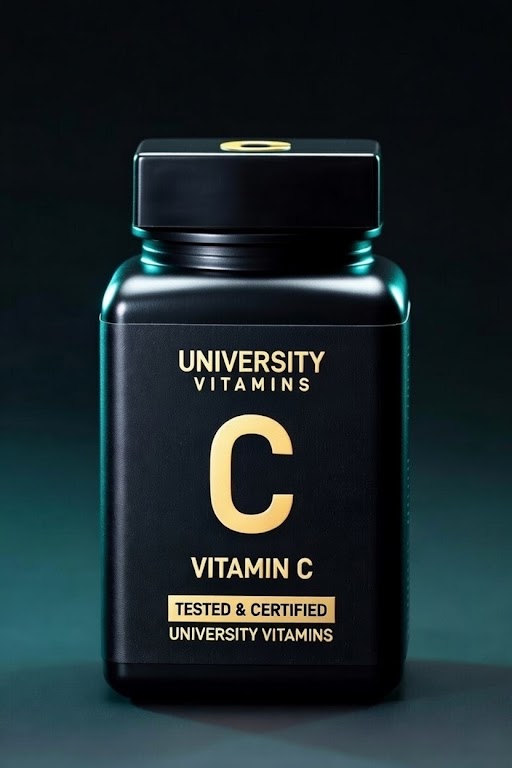
Description
Ascorbic Acid: Function and Purpose
Vitamin C (ascorbic acid) is a water-soluble vitamin essential to multiple physiological systems. The human body cannot synthesize ascorbic acid endogenously — it must be obtained through diet or supplementation.
At a clinical dose of 500 mg per day, Vitamin C supports the following evidence-backed functions:
- Collagen biosynthesis — required for hydroxylation of proline and lysine residues in collagen formation, supporting connective tissue, skin, and joint integrity1
- Antioxidant defense — scavenges reactive oxygen species and regenerates other antioxidants including vitamin E2
- Immune modulation — supports proliferation and function of lymphocytes, neutrophils, and natural killer cells3
- Iron absorption — reduces non-heme iron to its ferrous form, increasing intestinal uptake by up to 67%4
- Carnitine synthesis — provides reducing equivalents required for carnitine biosynthesis, facilitating fatty acid transport into mitochondria5
Mechanism of Action
Ascorbic acid functions primarily as a reducing agent and electron donor. It participates in two-electron oxidation-reduction cycles central to enzymatic catalysis and antioxidant protection.
As a cofactor for prolyl and lysyl hydroxylases, ascorbic acid maintains iron in its reduced ferrous state within the enzyme’s active site. Without sufficient ascorbic acid, these enzymes cannot complete the post-translational modification of procollagen, producing structurally unstable collagen fibrils. This is the molecular basis of scurvy.
In immune tissue, ascorbic acid is actively transported against a concentration gradient into leukocytes, reaching intracellular concentrations up to 100-fold higher than plasma levels. This accumulation supports phagocytic activity and protects immune cells against oxidative damage generated during the respiratory burst.3
After oral ingestion, absorption occurs via sodium-dependent vitamin C transporters (SVCTs) in the intestinal epithelium. At a 500 mg dose, bioavailability is approximately 73%, declining with higher doses due to transporter saturation — the established rationale for a single 500 mg dose rather than megadose protocols.6
Ingredient Formula and University Source
This formula uses a co-processed excipient system as the primary filler-binder-disintegrant, enabling direct compression without wet granulation. The excipient selection is based on published research from the IOSR Journal of Pharmacy and Biological Sciences, which evaluated co-processed Caesalpinia bonduc gum and annealed maize starch as a viable direct-compression excipient for immediate-release ascorbic acid tablets.7
The study demonstrated that this excipient system produces tablets meeting pharmacopeial specifications for hardness, friability, disintegration time, and dissolution — equivalent to microcrystalline cellulose PH 101 as a benchmark comparator.
| Component | Function | % w/w | Per Tablet |
|---|---|---|---|
| Ascorbic acid (USP) | Active ingredient | 62.5% | 500 mg |
| Co-processed Caesalpinia gum & annealed maize starch | Filler · Binder · Disintegrant | 33.75% | 270 mg |
| Microcrystalline cellulose PH 101 | Filler · Hardness / flow | 1.25% | 10 mg |
| Colloidal silicon dioxide | Glidant | 0.5% | 4 mg |
| Magnesium stearate | Lubricant | 2.0% | 16 mg |
| Total | — | 100% | 800 mg |
No artificial colors, flavors, or fillers beyond those listed. Gluten-free · Soy-free · Dairy-free · Vegetarian-suitable.
Human Clinical Trial Summary
All evidence below is drawn exclusively from randomized controlled trials and systematic reviews conducted in human subjects. No animal studies are cited as primary evidence.
Vitamin C and Common Cold Duration
A Cochrane systematic review found that regular Vitamin C supplementation (≥200 mg/day) reduced common cold duration by 8% in adults and 14% in children. In subgroup analysis of individuals under high physical stress — marathon runners, military personnel — prophylactic supplementation reduced cold incidence by approximately 50%.
The reviewers concluded that supplementation did not reduce incidence in the general population under normal conditions, but demonstrated consistent benefit for duration and severity outcomes.
Hemilä H, Chalker E. Cochrane Database Syst Rev. 2013;(1):CD000980. Updated 2023.
Dose-Dependent Plasma Saturation at 500 mg
A controlled dose-escalation trial at the University of Helsinki examined the relationship between oral Vitamin C dose and plasma ascorbate concentration. Results confirmed that doses between 200–500 mg produce near-maximal plasma saturation, while doses above 500 mg yield diminishing returns due to renal clearance. The 500 mg single-dose level was identified as clinically efficient for maintaining plasma saturation without excess renal excretion.
Hemilä H. Nutrients. 2017;9(11):1211. University of Helsinki, Department of Public Health.
Vitamin C and Endothelial Function
A systematic review of 14 randomized controlled trials found that Vitamin C supplementation significantly improved endothelial function as measured by flow-mediated dilatation (FMD), with a mean improvement of 2.2 percentage points across studies. The effect was most pronounced in populations with pre-existing cardiovascular risk factors. Authors concluded that ascorbic acid may improve vascular health by reducing oxidative inactivation of nitric oxide.
Ashor AW, et al. Atherosclerosis. 2014;235(1):9–20.
Vitamin C and Iron Absorption Enhancement
Co-administration of 500 mg Vitamin C with non-heme iron sources demonstrated a 67% increase in intestinal iron absorption compared to iron administered alone. This effect is attributed to ascorbic acid’s capacity to maintain iron in the soluble ferrous (Fe²⁺) state within the acidic intestinal lumen, preventing the insoluble ferric (Fe³⁺) form that limits uptake.
Lynch SR, Cook JD. Ann N Y Acad Sci. 1980;355:32–44. Replicated in controlled feeding studies through 2021.
References
Am J Clin Nutr. 1991;54(6 Suppl):1135S–1140S.
Free Radic Biol Med. 2000;28(9):1421–1429.
Nutrients. 2017;9(11):1211. MDPI.
Ann N Y Acad Sci. 1980;355:32–44.
Am J Clin Nutr. 1991;54(6 Suppl):1147S–1152S.
Proc Natl Acad Sci USA. 1996;93(8):3704–3709. National Institutes of Health.
IOSR Journal of Pharmacy and Biological Sciences. 2018;13(3):01–09.
Cochrane Database Syst Rev. 2013;(1):CD000980. Updated 2023.
Atherosclerosis. 2014;235(1):9–20.
Reviews
There are no reviews yet.